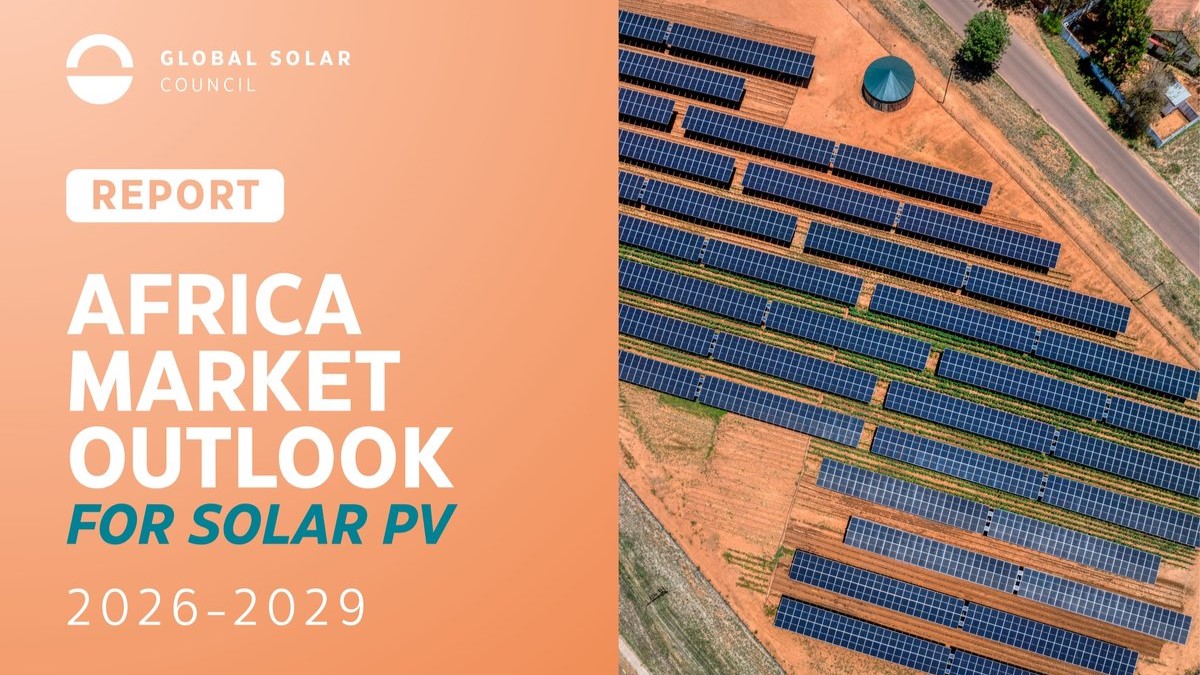
Africa recorded its fastest year of solar growth in 2025, with installations rising by 54% year-on-year, according to a new report by the Global Solar Council (GSC). The report finds growth is driven by two parallel solar transitions — utility-scale projects funded mainly by public and development finance, and rapidly expanding privately financed rooftop and distributed systems.
The Africa Market Outlook for Solar PV: 2026-2029, published by GSC in collaboration with its African member associations and supported by GET.invest and Octopus Energy, shows that recent solar equipment imports and deployment trends point to a broader, more diversified market — with households and businesses increasingly driving adoption beyond traditional utility-scale projects.
The report finds that solar deployment in Africa is increasingly spreading across a wider group of markets, reducing reliance on a small number of early adopters and strengthening the resilience of the continental solar sector. Import data provides clear evidence of this shift:
- Africa installed approximately 4.5 GW of new solar PV capacity in 2025, representing a 54% year-on-year increase and marking a sharp acceleration in annual deployment across regions.
- In 2025, the top 10 solar markets accounted for around 90% of new solar capacity additions, led by South Africa (1.6 GW), Nigeria (803 MW), Egypt (500 MW) and Algeria (400 MW), reflecting continued strength in large, established markets;
- At the same time, several mid-sized and emerging markets — including Morocco (204 MW), Zambia (139 MW), Tunisia (120 MW), Botswana (120 MW), Ghana (92 MW) and Chad (86 MW) — each added substantial new capacity in 2025, reinforcing a trend toward broader market participation.
- In 2025, 8 countries have installed 100MW or above, against 4 last year, essentially doubling the number of countries. Additionally, two countries were closing in on this threshold -(Ghana and Chad). This confirms the trend of diversification identified in last year’s report.
- While utility-scale has accounted for 56% of the installed capacity in 2025; it is important to note that the distributed capacity (44%) is clearly underestimated, as it is harder to track.
- Over the past 4 years, on average the utility scale deployment covered 15% of the imports, thus leaving a high share that cannot be explained by utility-scale projects alone, pointing to rapid and less accurately reported growth in distributed, commercial, and rooftop solar.
- Africa imported 18.2 GW of solar modules in 2025, yet under a medium installation scenario, African countries could install 14.3 GW of mainly utility-scale capacity across 2026–2027 combined. This means that one year of imports exceeds two years of utility-scale deployment. The mismatch between module imports and projected utility-scale installations strongly indicates that distributed solar represents a substantial share of Africa’s solar market.
- Looking ahead, the report’s medium-term outlook suggests Africa could install 21% CAGR by 2029, as distributed and utility-scale markets continue to expand in parallel across a growing number of countries.