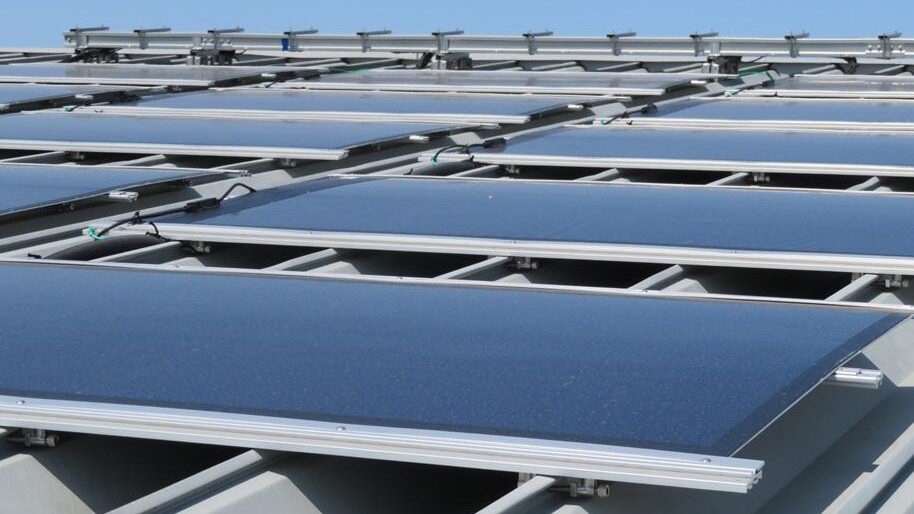
Kyocera Communication Systems Co., Ltd. (KCCS), a technology and engineering subsidiary of the Japanese conglomerate Kyocera, has announced that it has begun testing perovskite solar module technology developed by Sekisui Chemical, a Japanese plastics manufacturer. The trials are being conducted at six of KCCS’s facilities located in the prefectures of Fukuoka and Shiga.
The pilot projects are supported by Japan’s Ministry of the Environment, as well as by the governments of the two prefectures, according to Kyocera’s statement.
“In recent years, the adoption of renewable energy has accelerated in efforts to achieve a decarbonized society. However, the limited availability of suitable sites for installing solar power generation facilities has become a growing challenge,” the company said. “Film-type perovskite solar cells are attracting attention as a promising solution to this issue. Because they are lightweight and flexible, they can be installed in locations where conventional silicon-based solar panels are difficult to use due to load-bearing restrictions. As a result, they are expected to play an important role as a new technology supporting the realization of a sustainable society.”
Last year, Sekisui Chemical announced commissioning of a 100 MW perovskite solar cell production line. A few months later, it said it was collaborating with Japan’s Bank of Mitsubishi UFJ (MUFG Bank), a subsidiary of Mitsubishi UFJ Financial Group, to carry out two perovskite panel demonstrations at two sites owned by the bank.
The company has also a number of projects with diverse partners at sites in Japan that experience a variety of weather conditions and configuration requirements, including agrivoltaics, as well as a cooperation on perovskite solar cell technology with the Slovak Ministry of Economy.
Sekisui Chemical reiterated in the announcement that it is developing a novel 30 cm-wide roll-to-roll manufacturing process for perovskite solar panels with an initial power generation efficiency of 15.0% and an outdoor durability equivalent to 10 years. It is concurrently working on improving durability, power generation efficiency, and scaling up to web widths of 1 m.
In late November 2025, Japan’s Ministry of Economy, Trade and Industry (METI) said that it plans to deploy around 20 GW of new PV systems based on perovskite solar cell technology by 2040.