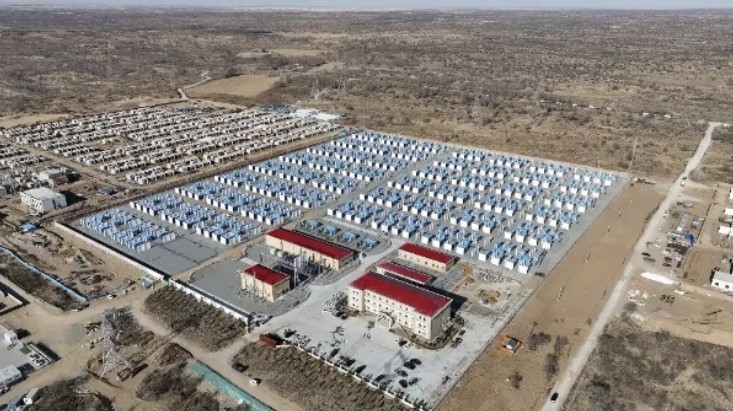
A 500 MW / 2,000 MWh standalone BESS in Tongliao, Inner Mongolia, has begun commercial operation following a five-month construction period, reflecting China’s accelerating rollout of large-scale storage to firm and integrate high penetrations of wind and solar generation.
Developed and financed by Tongliao Conch New Energy Co., Ltd., a subsidiary of China’s largest cement manufacturer the Conch Cement Group, the project – located in Naiman Banner, Tongliao – represents Inner Mongolia’s largest single-site new-type storage facility. Construction began on June 28, 2025, and the plant completed grid connection tests and acceptance on November 28, 2025, one month ahead of schedule, with a total investment of about CNY 1.5bn.
The project features lithium iron phosphate (LFP) battery technology and a 220kV booster substation, enabling direct connection to the regional high-voltage network. Annual peak–valley shifting is expected to reach about 600 GWh, with a maximum annual throughput of 1.5 TWh, equivalent to around 4% of the local marketized power volume.
On the AC side, Kehua supplies 5MW centralized PCS–step-up integrated units, combining conversion and step-up in a single skid to simplify on-site installation, commissioning and maintenance. The PCS features an IP65 protection rating for dust and water and is designed to operate in −35°C, high-wind, high-sand conditions typical of eastern Inner Mongolia. Kehua says the equipment achieves peak conversion efficiency above 99% and incorporates fan reverse-rotation self-cleaning and modular design to reduce manual maintenance and improve fault isolation.
On the DC side, CATL provides 5MWh containerized storage systems based on its 314Ah storage cells, one of China’s earliest mass-produced 20-ft 5MWh solutions. CATL’s reliability program, spanning material selection, platform standardization, fully automated production and intelligent testing and grouping, is claimed to drive cell safety-failure rates down to the parts-per-billion (PPB) level. According to CATL, over the full lifecycle, the cell platform is expected to increase discharged energy by about 3–5% versus comparable products while lowering maintenance costs.
Once connected, the project participates as an independent storage asset in the North China’s Mengdong power market, charging mainly during periods of high wind and solar output and discharging into the grid during off-peak generation and demand peaks. The plant is designed to deliver peak shaving and valley filling, frequency and voltage support, ramp-rate smoothing and power quality improvement, directly addressing the curtailment and grid-balancing challenges created by high renewable penetration in Naiman Banner and surrounding counties.
Local authorities frame the project as both an engineering and schedule benchmark -“Tongliao speed” – and as a template for integrating large-scale standalone storage into regional power markets. For Inner Mongolia, which is positioning itself as a national energy and strategic resource base, the plant is expected to provide a cornerstone asset for the emerging new-type power system, while offering a “Tongliao solution” for other provinces seeking to combine large renewables bases with grid-forming storage.