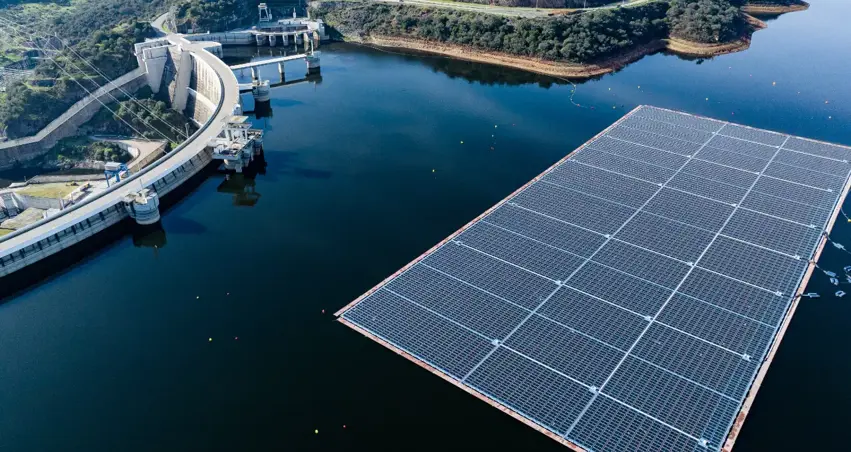
Türkiye’s rules for using water surfaces for floating solar installations have been published in the country’s Official Gazette (Resmi Gazete).
The move follows the Turkish government amending coastal laws governing the construction of renewable energy sites in seas, dam lakes, artificial lakes and natural lakes last year, which permitted the nation's first floating solar tender, for a 35 MW project at the site of an existing hydroelectric plant, last month.
The regulatory framework, now in force, governs the design, installation, operation and oversight of floating solar on reservoirs and canals.
It stipulates that floating solar coverage cannot exceed 10% of a reservoir at normal water level or 30% at minimum water level and prohibits floating solar at legally-restricted water bodies, protected areas, flood-control reservoirs and reservoirs with a surface area under 0.5 km2.
In reservoirs, floating solar arrays must be no larger than 10 hectares each, placed at least 25 meters horizontally from minimum water level boundaries and spaced at least 30 meters apart. They must also be capable of withstanding wind, waves, snow and water-level fluctuations. Anchoring, cables and panel placements must not obstruct dam operations.
In canals, floating solar must be built on an overhead structure that does not touch the water. An array can be a maximum 250 m, with 25 m gaps between installations, and must not impact canal maintenance or water flow.
Future floating solar projects will require approval from both state agency Devlet Su İşleri (DSI) and Türkiye’s national energy regulator prior to construction, as well as verification from DSI prior to final acceptance.
For projects approved or contracted before this regulation, developers are expected to submit an updated feasibility report within three months.
Turkey added 3.1 GW of solar during the first half of this year, taking cumulative solar capacity past 23 GW. As of September, combined solar and wind capacity had exceeded 37 GW, equivalent to almost 31% of the country’s installed energy capacity. Turkey is aiming to reach 120 GW of solar and wind energy capacity by 2035.