Total investment in the Caspian–Black Sea–Europe Green Energy Corridor project is estimated at approximately €22.1 billion.
According to Renewables.Az's analysis of the project's investment document, €14.3 billion of the total investment is allocated to electricity transmission infrastructure, while €7.8 billion is earmarked for renewable energy generation capacity dedicated to the corridor.
According to the feasibility study conducted by Italian consultancy CESI, €14.3 billion is allocated to electricity transmission infrastructure, while €7.8 billion is earmarked for dedicated renewable energy generation capacity.
Project configuration and implementation timeline
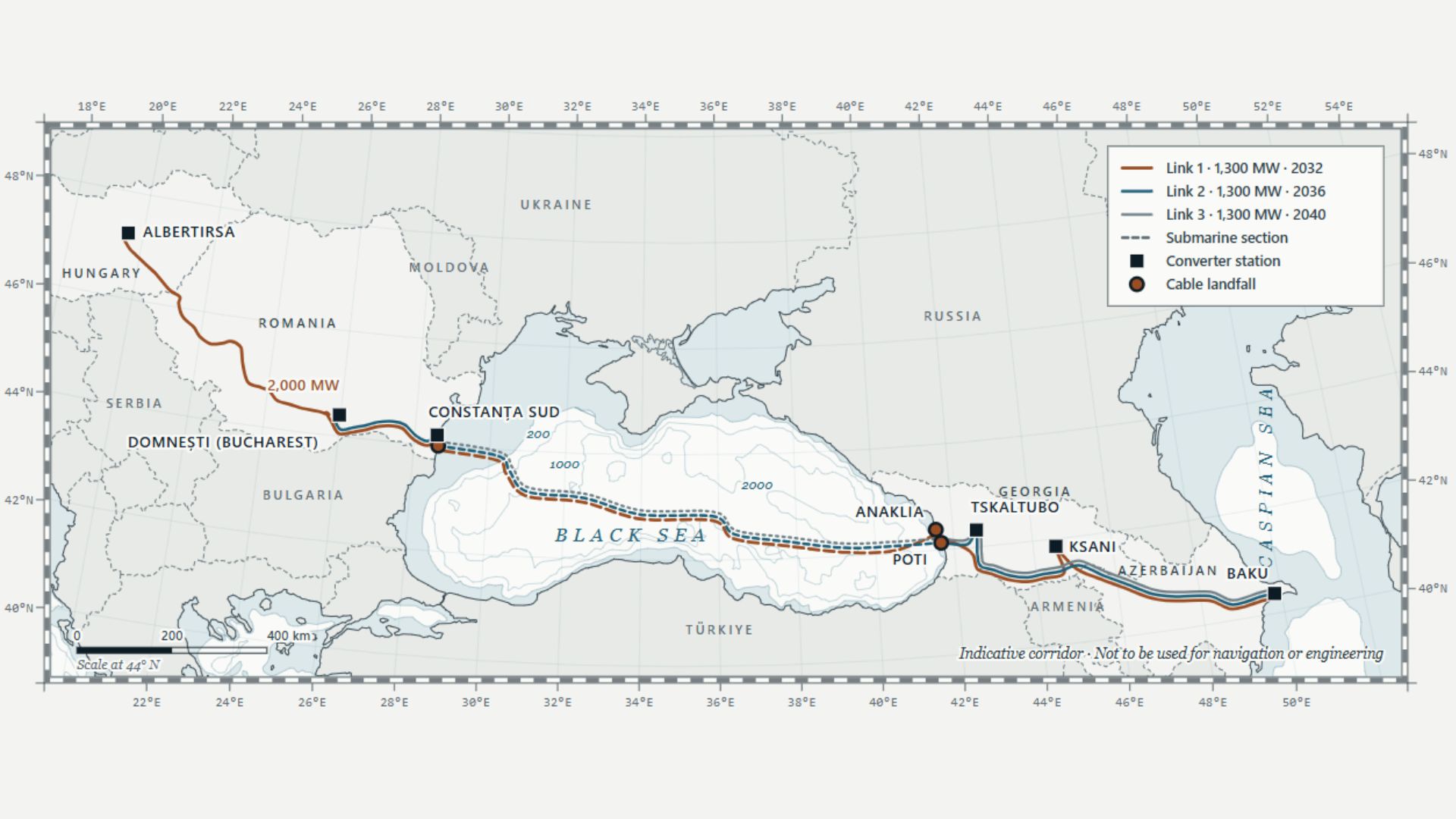
The Green Energy Corridor will connect Azerbaijan, Georgia, Romania and Hungary through three independent high-voltage direct current (HVDC) transmission links.
Each link will use voltage-source converter (VSC) technology, operate at ±525 kV and provide 1,300 MW of transmission capacity. The corridor's total capacity will reach 3,900 MW upon full completion in 2040.

The project will be developed in three phases:
- Link 1 — 2032: Baku–Ksani–Anaklia–Constanța Sud, with a 2,000 MW onshore extension from Romania to the Albertirsa substation in Hungary. The total route length is approximately 3,040 km, with 1,300 MW of HVDC transmission capacity.
- Link 2 — 2036: Baku–Tskaltubo–Poti–Domnești (Bucharest), extending approximately 2,340 km with a capacity of 1,300 MW.
- Link 3 — 2040: Baku–Tskaltubo–Poti–Constanța Sud, extending approximately 2,020 km with a capacity of 1,300 MW.

The first two links are associated with project reference 1248 in ENTSO-E's Ten-Year Network Development Plan (TYNDP), while the third is associated with reference 1244.
Overhead and underground transmission lines will cross Azerbaijan and Georgia to the Black Sea coast.
Converter stations at Ksani and Tskaltubo will provide bidirectional connections to Georgia's electricity grid, enabling the country to export surplus renewable electricity and import power when needed.
From the Georgian coastal landfalls at Anaklia and Poti, submarine cables will cross the Black Sea to Romania. Each subsea cable route will extend approximately 1,120 km, reaching maximum laying depths of around 2,200 metres. Fibre-optic cables will accompany the power transmission infrastructure.
The corridor will connect to the European Union electricity grid at Constanța Sud, Domnești and Albertirsa.

Electricity exports and economic benefits
The feasibility study projects annual renewable electricity exports to the European Union of 8 TWh from 2032, increasing to 20 TWh by 2040.
Interconnector load factors are expected to reach 60–70% or higher over the assessment horizon.
Congestion revenues are projected to exceed €315 million annually from 2032.
The project is also expected to contribute to lower wholesale electricity prices in Romania and Hungary by displacing part of the electricity generation currently supplied by gas-fired power plants.
Annual carbon dioxide emissions reductions are projected to reach 3.6 million tonnes by 2040.

Economic performance
According to CESI's cost-benefit analysis, the project has an economic net present value of €26.6 billion, calculated using a 4% social discount rate, and an economic internal rate of return (IRR) of 11.7%.
The economic IRR is expected to remain above the assumed discount rate even in a scenario involving a 20% increase in project costs.
Annual economic benefits are projected to increase as successive links enter operation:
- 2032 — €860 million;
- 2036 — €1.8 billion;
- 2040 — more than €3 billion.
Approximately €1.7 billion of the projected annual economic benefits in 2040 is attributable to the economic value of avoided CO₂ emissions.
Hybrid business model and financing structure
The proposed financing structure combines public and private capital through a hybrid regulated and merchant transmission model.
Each 1,300 MW HVDC link will be divided into two components:
- Regulated component — 500 MW: Revenues will be based on a regulated asset base (RAB), with an assumed real pre-tax weighted average cost of capital (WACC) of 8% and a depreciation period of 40 years.
- Merchant component — 800 MW: Revenues will be generated through congestion income and long-term transmission rights.
Under the proposed merchant model, the break-even price for long-term transmission rights is estimated at approximately €34/MWh with EU grant support and €46/MWh without grants, calibrated to achieve an equity return of at least 10%.
The financing assumptions include 80% debt financing, with repayment over approximately 30 years.
The financial model also assumes an EU grant covering 25% of capital expenditure. However, eligibility for funding under the Connecting Europe Facility (CEF) remains subject to confirmation.
Investment and partnership opportunities
The investment presentation identifies several opportunities for participation by public and private investors.
These include strategic equity investment in the merchant transmission vehicle, long-term loans and guarantees from multilateral development banks, export credit agencies and commercial banks.
Additional opportunities include EU grant financing through Projects of Mutual Interest (PMI) status and the CEF mechanism, long-term power purchase agreements (PPAs), transmission rights, cable and converter equipment supply, and marine installation services.
Green hydrogen prospects
The feasibility study also examined green hydrogen production, storage, demand and transportation across Azerbaijan, Georgia, Romania and Hungary.
Under the reference scenario, combined domestic green hydrogen demand in the four countries is projected to increase from approximately 440,000 tonnes in 2032 to 875,000 tonnes in 2040.
By 2040, demand is estimated at 471,000 tonnes in Romania, 269,000 tonnes in Hungary, 85,000 tonnes in Azerbaijan and 49,000 tonnes in Georgia.
Total electrolyser capacity under the modelled pathway is projected to rise from approximately 2.7 GW in 2032 to 7.6 GW in 2040.
The 2040 distribution comprises 5.5 GW in Hungary, 1 GW in Azerbaijan, 0.6 GW in Georgia and 0.5 GW in Romania. The modelled electrolyser capacity is intended to serve domestic hydrogen demand.
Azerbaijan's levelised cost of green hydrogen production using a combination of wind and solar energy is estimated at approximately €2.9/kg in 2030, compared with around €3.7/kg for green hydrogen produced in Europe, according to the EBRD benchmark cited in the assessment.
The study also evaluated a potential dedicated hydrogen pipeline along the Baku–Georgia–Black Sea–Romania–Albertirsa route.
The proposed pipeline would extend approximately 3,000 km, including around 1,900 km onshore and 1,115 km offshore across the Black Sea. Where possible, the route would follow the electricity corridor to share permitting and construction activities.
Five pipeline configurations, ranging from 16 to 36 inches in diameter, were assessed, with annual hydrogen transport capacities of 100,000–950,000 tonnes, equivalent to approximately 3.3–31.7 TWh.
Preliminary investment requirements were estimated at €6.6–13 billion, depending on pipeline size.
However, the feasibility study concluded that none of the assessed hydrogen pipeline configurations would be economically viable during the 2030–2040 period under the reference assumptions.
This reflects downward revisions to expected EU hydrogen imports before 2040 compared with earlier REPowerEU targets, as well as the adoption of a “Late Adoption” hydrogen scenario following stakeholder consultations.
Consequently, the current development phase prioritises HVDC electricity transmission rather than a dedicated hydrogen pipeline.
Nevertheless, the study identifies hydrogen as a potential long-term opportunity. Under a high-production scenario, Azerbaijan could meet 10–15% of the EU's hydrogen import requirements by 2040.
Pipelines are also considered a cost-effective option for hydrogen transportation over distances of up to approximately 3,000 km, making the corridor relevant for potential future hydrogen exports.
Furthermore, renewable generation capacity developed to support the HVDC links could also supply electricity to electrolysers in Azerbaijan and Georgia.

Next development phase
The feasibility study was approved at the 12th Ministerial Meeting of the participating countries, held in Baku on July 8, 2026.
The Green Energy Corridor has now entered its development phase, including tender preparations, implementation roadmap development and work towards a final investment decision (FID).
Green Energy Corridor Power Company (GECO) is inviting expressions of interest from potential investors and strategic partners.
The company will also continue reviewing the hydrogen transportation option as the European hydrogen market develops.