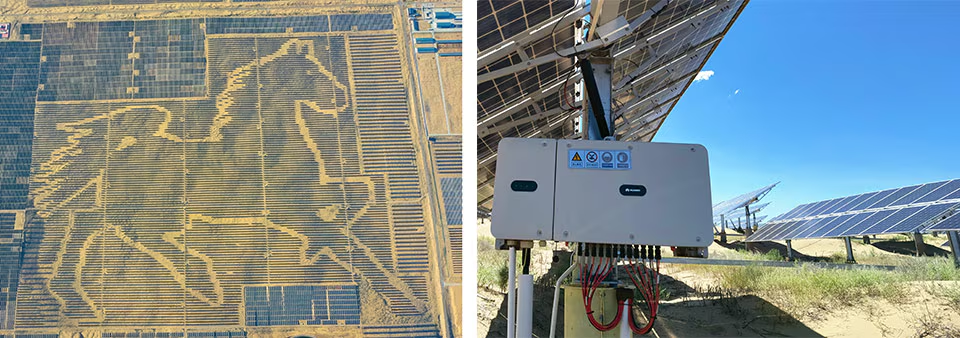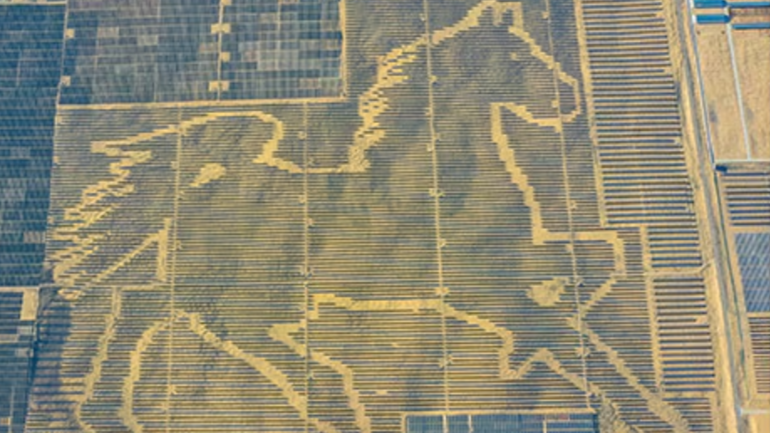
A solar power station shaped like a galloping horse now stretches across part of the Kubuqi Desert in Inner Mongolia, China, built by the State Power Investment Corporation using Huawei's smart photovoltaic (PV) technology.
According to the QazaqGreen, located in Dalad Banner, the 300 MW facility uses around 196,000 solar panels arranged to form the outline of a running horse when viewed from above.
By the end of 2022, the station had generated roughly 2.566 billion kWh of electricity — output the operators say is equivalent to saving over a million tons of coal and avoiding about 2.56 million tons of CO2 emissions. Construction of the plant has also helped stabilize more than 1,000 hectares of shifting sand.
Beyond power generation, the site doubles as a testing ground for desertification control. Local residents grow herbs and shrubs in the shade beneath the panels, while cash crops such as desert false indigo and Mongolian milk vetch are planted in the strips between panel rows. The vegetation helps anchor the soil, limit wind and sand erosion, and support broader ecosystem recovery in the area.
Officials have pointed to the Dalad Banner project as a model for combining solar power generation with land restoration, and similar PV-based desertification-control efforts are reportedly being planned for other desert regions across western China.