The Middle East and North Africa (MENA) region installed 12.2 GW of solar in 2025, according to a new report from energy transition thinktank Dii Desert Energy.
The Renewables, Hydrogen and Energy Storage developments in the MENA region report says the 17 countries that make up the MENA region now have a cumulative solar capacity of 34.5 GW. With total renewables capacity currently totalling 43.7 GW, up from 30.3 GW at the end of 2024, solar stands as the dominant renewables technology in the region.
Saudi Arabia has become the country in the region with the largest operational solar capacity. The kingdom inaugurated several massive solar projects in 2025, taking combined capacity past 11 GW.
The UAE now places second regionally with over 6.5 GW of solar as it continues to expand the world’s largest solar park. Egypt and Jordan place third and fourth, with 2.5 GW and 2.1 GW of operational solar respectively. Last year saw Oman become the fifth country in the region to pass the 1 GW threshold, with the switching on of the Manah I and II projects taking capacity past 1.6 GW.
The report says the MENA region’s transition towards sustainable energy is now accelerating beyond previous expectations.
The region’s pipeline of renewables projects has surged from 131 GW a year ago to 202 GW. Solar continues to lead the way, accounting for 130 GW of the total. Of the total 202 GW, 43.7 GW is operational, 38 GW is under construction, 34 GW is under development and 87 GW is classified as announced or with a memorandum of understanding signed.
The pipeline is now drawing close to the MENA region’s aggregated national ambitions for renewable energy by 2030, which currently stands at 235 GW. “If the current momentum continues, solar deployment will likely drive the region to exceed its aggregate goals,” the report predicts.
As a result, Dii Desert Energy has updated its scenario framework projecting pathways to 2030, setting a conservative baseline of 165 GW of renewables, matching the cumulative national targets of 235 GW under a ‘balanced’ scenario and setting a ‘green revolution’ scenario of 290 GW which the report says represents the region’s full potential.
“The gap to this target has narrowed significantly, but bridging it will still require sustained momentum, supply chain resilience and the continued mobilization of capital,” the report says.
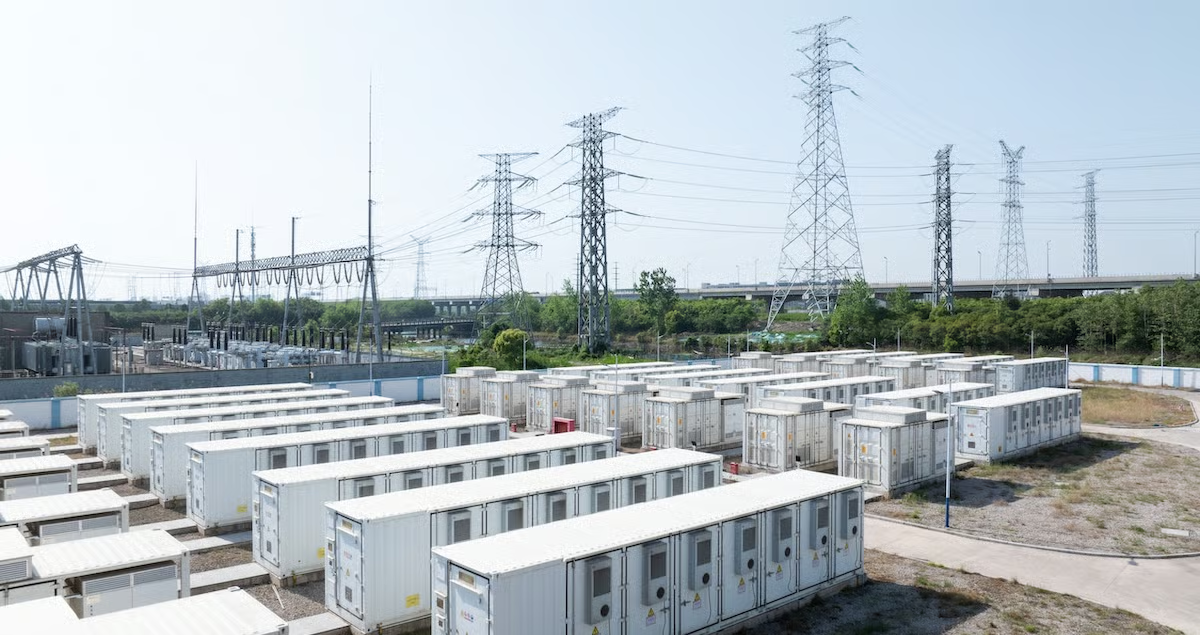
Dii Desert Energy also highlighted the MENA region saw solid growth in its utility-scale energy storage market in 2025, with around 25 GWh of operational capacity today that is expected to expand sixfold to 156 GWh by the end of the decade.
It notes that the storage market is shifting away from thermal energy storage systems coupled with concentrated solar power plants, towards battery energy storage systems (BESS) that now account for 50% of operational capacity.
BESS projects are being developed both as standalone and co-located with solar. “The market tipping point was when the cost of BESS plummeted by around 80% or more from a decade ago, and MENA storage demand rose due to increased renewable energy sources within the grid,” the report explains.