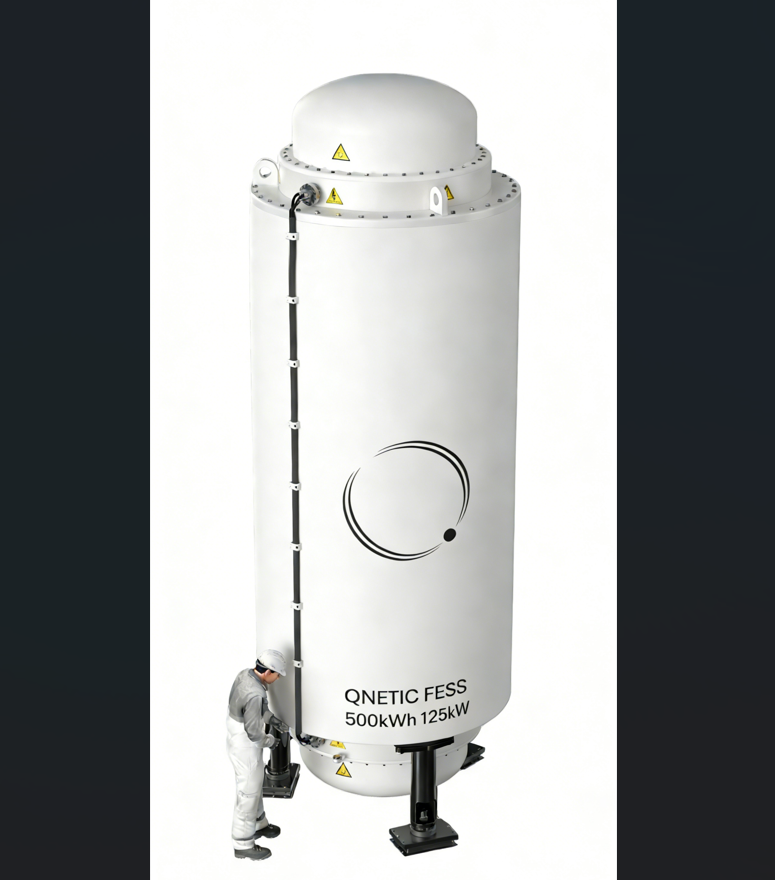
Following a lucrative 2025, New York-headquartered flywheel energy storage systems (FESS) startup Qnetic is fitting out a factory in Sacramento, California where it will begin low-volume manufacturing of its Q500 solid-state mechanical battery.
The Q500 is Qnetic’s alpha prototype product, its CEO Michael Pratt confirmed to ESS News. “The basic spec of Q500 is 500 kWh, 125 kW, four hours discharge at max power, and up to 12 hours discharge at lower power. The first prototypes will be derated from 500 kWh to 100–200 kWh as we build up qualification data to increase rotor speed and hence capacity,” said Pratt.
According to the company, its design differentiates the battery from standard short duration FESS and makes it more grid friendly.
“Traditional FESS are built for high power, short duration and low energy capacity,” its website says. “Qnetic is the opposite: long-duration, high energy capacity and moderate power.”
Pratt added that Qnetic is also in the process of developing another more advanced system. “The product roadmap goes from Q500 – our launch product being built now – to Q1 (or some other variant) in due course,” the executive said. “The Q1 will be an evolution of the Q500, with similar architectures, so the technologies we have patented exist in both,” he explained.
The company has been on a steady path of expansion over the past few months to prepare for its next phase of commercialization. Its 2025 Wefunder equity crowdfunding campaign raised $2.1 million, bringing its total funds raised over the past 12 months to $7.1 million and its total to date to $9.2 million.
It has backing from an un-named Saudi Arabian investor and venture capital firm SOSV. Over the next two years it will expand field testing and validation work with partners such as the National Lab of the Rockies and the Electric Power Research Institute (EPRI). The partners will formally assess and validate the FESS across multiple use cases.
Pratt said the startup aims to field its first systems in 2026 and aims to raise $20 million to fund its development. In a 2025 H2 update addressed to investors, the company said it anticipates raising “around double” the amount it raised in 2025. It said investor discussions are underway.
In early March 2026, the company opened another equity crowdfunding campaign (known as RegCF in the US) for $5 million to kick off its 2026 funding push. It follows what Pratt called “an enthusiastic response” to the company’s earlier public offering.
A spokesperson for Qnetic told ESS News that the company opted for the public offering funding model because it enables retail investors to participate, amplifies market awareness, and offers a relatively predictable path to funding. The crowdfunding approach is also more efficient in terms of total cost and resources, the spokesperson added.
As well as the US, Qnetic has branches in Shanghai, Singapore and Germany.
In 2025, the startup began operations at its Shanghai Technology Center where it is testing the Q500 product. The facility also houses its earlier prototype Vega, which is being used as a tool to pre-test Q500 technologies and other future technology iterations.
In 2023, Qnetic partnered with Bürgerwindpark Janneby in northern Germany to install, test, and validate prototypes of its grid-scale ESS.
The company is also working with several US utilities and independent power producers. In 2026 or 2027, it aims to deploy one or two units for an evaluation with a major utility, and its research partners will publish results of the tests to the utility’s membership.